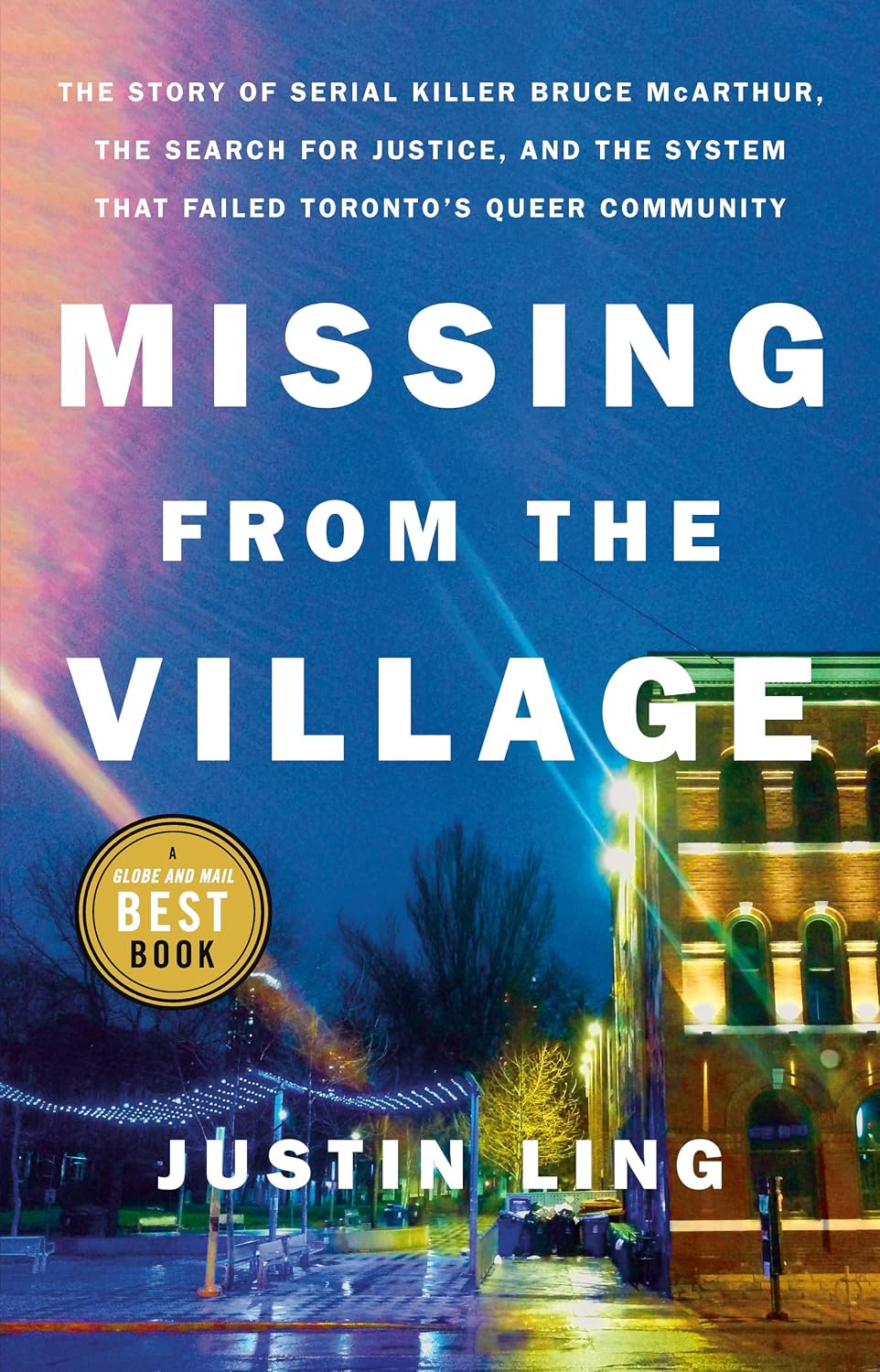
 For a husky sexagenarian, Toronto’s Bruce McArthur did well on the online hookup scene. He regularly met other local men for purposes of intimacy. Only when circumstances permitted, he also strangled them to death. The circuitous manhunt that ultimately led to McArthur, and the community’s psychic decimation in the wake of his actions, are ably recounted in journalist Justin Ling’s Missing from the Village.
A long-time reporter for VICE who’s also written for Maclean’s and The Globe and Mail, Ling is a member of the queer community McArthur attacked from within. From the vantage point of participant-observer, he documents the paranoia, anger and fear pervading that community as gay and bisexual men start to vanish, Toronto Police Service repeatedly asserting no known connection between them. Early in the case, Ling latches onto a theory held by many, ultimately proven to be true: the community had a serial killer in its midst.
The book focuses on McArthur’s victims as much as their killer. Ling shines when profiling each murdered man better than the mass media, engaging in expert detective work to uncover the daily realities of the more marginalized victims, like refugee Kirushnakumar Kanagaratnam and street sex worker Dean Lisowick. Ling also takes great pains to set his book in a broader cultural context—a history of brutality against the queer community by the police and community at large; one that, he argues, reflects a cultural notion that queer lives are less worthy, and expendable.
The author’s style is vernacular and accessible. While it’s natural to want to understand why someone would commit such heinous acts, Ling doesn’t broach the issue. He sets aside the question of motive, asserting “the cottage industry of serial-killer profiling is a lot of quackery.” Missing is as much about the case as Ling’s chasing of the case; his account of his own travails is interesting, but could have been condensed. Similarly, a tangential subplot about how investigators erroneously feared some of the missing men had been cannibalized should have been reduced to a footnote.
Missing from the Village, naturally, traffics heavily in community–police relations. After all, McArthur was known to police years before his arrest—he had twice to their knowledge violently assaulted sexual partners, and had been initially identified as a person of interest in the investigation into three of the murders several years prior.
For many, that arrest was cold comfort, given widespread sentiment lives could have been spared were McArthur captured sooner—given that the murders were spread out over an eight-year period, and if anything seemed to kickstart again after the initial investigation halted in 2015. According to Ling, inconsistencies in the “versadex,” an internal crime database, may account for police inability to connect the dots to McArthur much earlier.
On the question of police accountability, Ling is even-handed. He supports calls to defund the cops—noting that social services may be better placed to support missing-persons investigations. But he sings praise for determined investigators without whom McArthur would never have been apprehended.
For interested members of the public as well as those directly affected and seeking closure, Missing from the Village bears respectful witness to this terrible story—from the sights and sounds of the night the first man disappeared to the plaintive and heart-wrenching victim-impact statements delivered when Bruce McArthur pleaded guilty. A worthy record of an unfathomable tragedy.
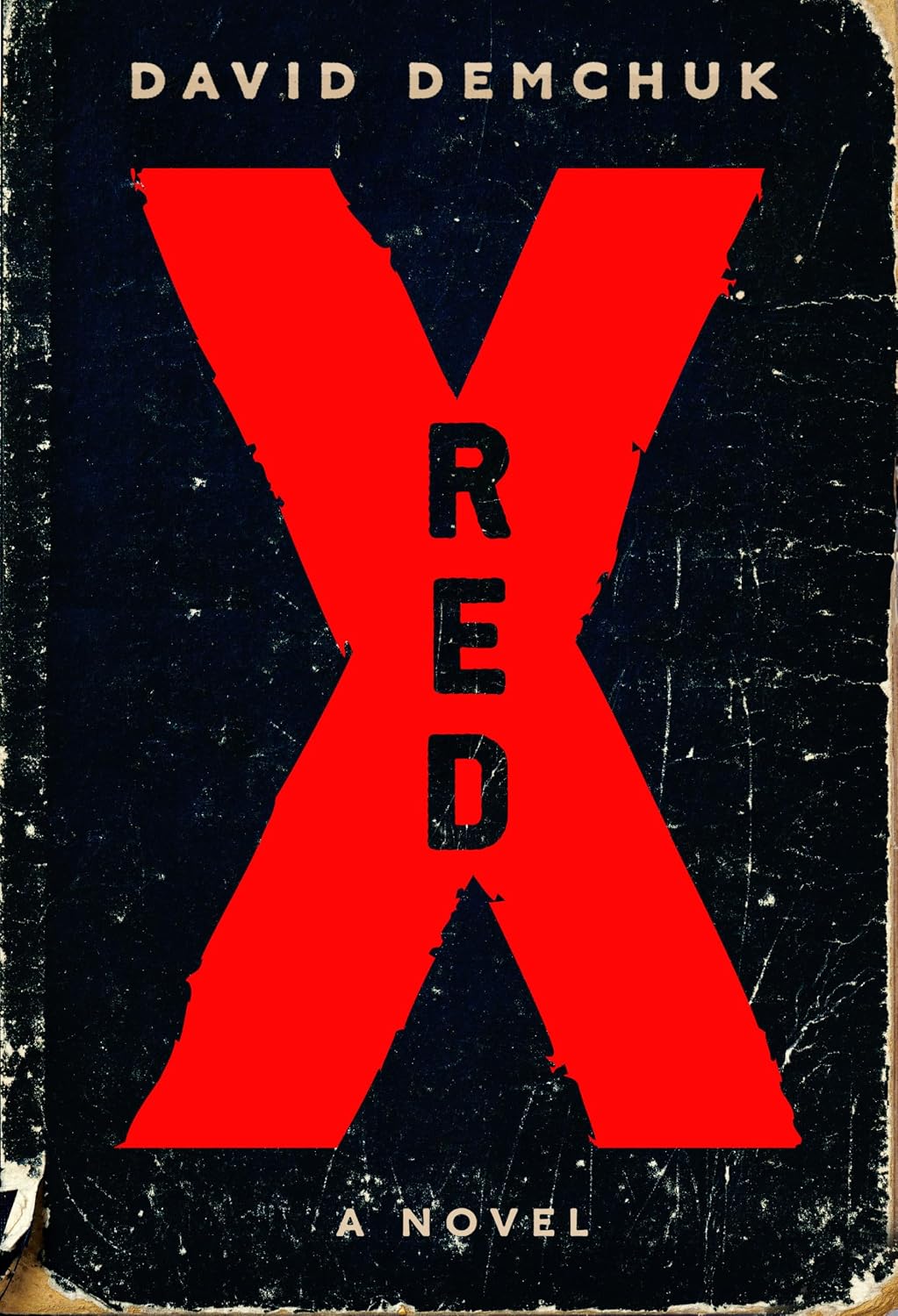 Author and playwright David Demchuk was deeply affected by Toronto serial murderer Bruce McArthur’s killing spree—he knew one of the victims personally. But what if the unexplained disappearances of gay and bisexual men could be caused by something else, something supernatural? That is the premise behind Demchuk’s disturbing and provocative horror novel, Red X.
The Toronto-based Demchuk, whose debut novel, The Bone Mother, was longlisted for the Giller Prize, blurs lines between reality and fiction in this new, formally experimental work. At one point in the narrative, Demchuk, as himself, has a Facebook Messenger conversation with Salem, one of Red X’s characters, about research that he did for the previous novel. Demchuk’s creative disruptions extend to the production of the book itself; at a key moment in the text, a series of pages feature distorted text with simulated blood streaking down the page.
The story spans thirty-two years, with five chapters each set eight years apart, from 1984 to 2016. As an ensemble cast with diverse racial and gender identities comes of age in Toronto’s rapidly gentrifying LGBT village, those they care about are disappearing one by one. The police are little help; in fact, the cops depicted here are queer-bashers, closet cases and rapists. As friends piece together clues, some commonalities emerge—finding and reading “a blood-red book, inscribed with charms,” bodily markings (in the form of the titular red X), and encounters with a seductive young creature named Nicholas, whose appetites are graphically depicted and most unnatural (those with a taste for gore should be satisfied, though the truly grisly sections are sparingly apportioned).
Interspersed between the fictional segments are a suite of personal essays in which Demchuk discusses the history of queerness within the horror genre, the real-life McArthur killings, and his own persistent phobias (or as he calls it, “my life in fear”). His relationship to his body is explored, including a harrowing account of his lifelong struggle with a rare, and potentially fatal, recurring paralysis disorder. What emerges is a portrait of an author and a genre made for one another.
The author establishes a persistent air of disquiet. Rank smells abound. Animals seem harnessed by unseen forces—a hawk flies overhead warily, a gang of hounds menaces, a small bird suddenly smashes into a window. Characters are uniformly hypervigilant—nearly any time any character is alone, she feels as if she is being accompanied, watched or followed. Demchuk’s unconventional approach to storytelling holds readers close, speaking directly to them and sharing in the terror.
“For centuries, queerness and horror have been intertwined, horror relying on queerness for shock and pungency, and queerness relying on horror for visibility and validation,” Demchuk notes in an essay, adding “queer characters could take a role at the heart of the story, albeit as predatory unnaturals with perverse desires.” In Red X, he gets to have things both ways—a voracious, queer monster shares the pages with a slate of fully realized, human LGBT characters whose lives, if not for its menace, would be utterly ordinary.