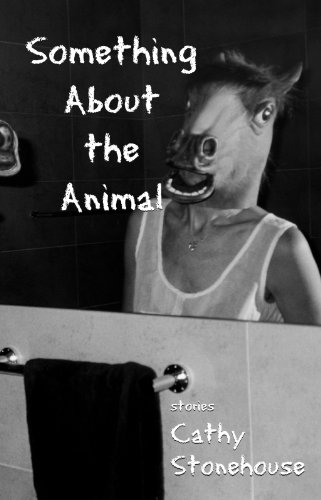
 In her short-fiction collection Something about the Animal, East Vancouver author Cathy Stonehouse is deeply concerned with survival. Many of the characters who inhabit these sixteen stories withstand physical and emotional brutalization—in a single story, for instance, the reader will encounter cutting, sex work, heroin, sex between prepubescent children and adult relatives, parents who beat their kids, suicide ideation and a sexual liaison that turns into a murder attempt.
Through an uncompromising focus on intense subject matter, Stonehouse deftly explores considerations that range from the exploitation of power imbalances to the precariousness of mental health. Her thematic daring is complemented by straight-forward, unsensational prose. Leavened with occasional wry humour, the stories that delve most deeply into psychic pain tend to be the most complex and successful.
The book repeatedly addresses the notion of migration away from one’s place of origin, perhaps reflecting Stonehouse’s experience as a UK émigré. Her characters are usually distancing themselves from trauma or conflict, and often keep aspects of their identities hidden. In “A Special Sound,” Gaynor and her father relocate from Northern Ireland to London, seeking to obscure and transcend their family’s past involvement in the IRA. They change names, pretend not to be Catholic. The story is told from Gaynor’s point of view, and Stonehouse skilfully parcels out the story’s somewhat complicated details from the perspective of her young, disoriented protagonist, right up until a tragic ending.
Some characters’ secrets are as dramatic but incredibly intimate. In “Where I Live Now,” a man returns from Canada to England to clean out his just-deceased father’s house. In the process, he’s forced to revisit experiences that have haunted his entire existence—his child-pornographer dad anally raped him from the age of 6, capturing the violation in a series of photographs. In clean, simple prose, Stonehouse reveals how in adulthood the man’s eroticism has become warped because of the prior abuse, his ability to form romantic relationships stunted. He responds viscerally to symptoms of predatory sexual behaviour he witnesses in other fathers and sons—but just as when he was a boy, he feels paralyzed in their midst.
The book opens with “Beryl Takes a Knife,” in which a house-bound woman copes with the aftermath of childhood trauma. She was sexually assaulted in a wardrobe at age twelve by a shoe salesman who was her mother’s lover. She gave birth to the rapist’s child, which was subsequently taken away from her. Though elements of this story recall “Where I Live Now,” each narrative is stylistically distinct. “Where I Live Now” moves back and forth in time, focusing upon the protagonist’s engagement with the world around him, but ultimately ending on a note of sheer disconsolation. Meanwhile Beryl is a solitary, unreliable narrator who expresses hope despite her unwillingness to leave her house. The story is structured as a ceaseless internal monologue reflecting the claustrophobic nature of her existence.
Something about the Animal is a provocative literary effort, both artful and brave. Though some may find her concerns extreme, Stonehouse’s thematic preoccupations describe realities that many people experience. Some readers may find Something about the Animal resonant and even validating. Others may confront the ways in which, though our measures of privilege and pain are variable, perhaps all of our lives are not so different after all.